



 ">
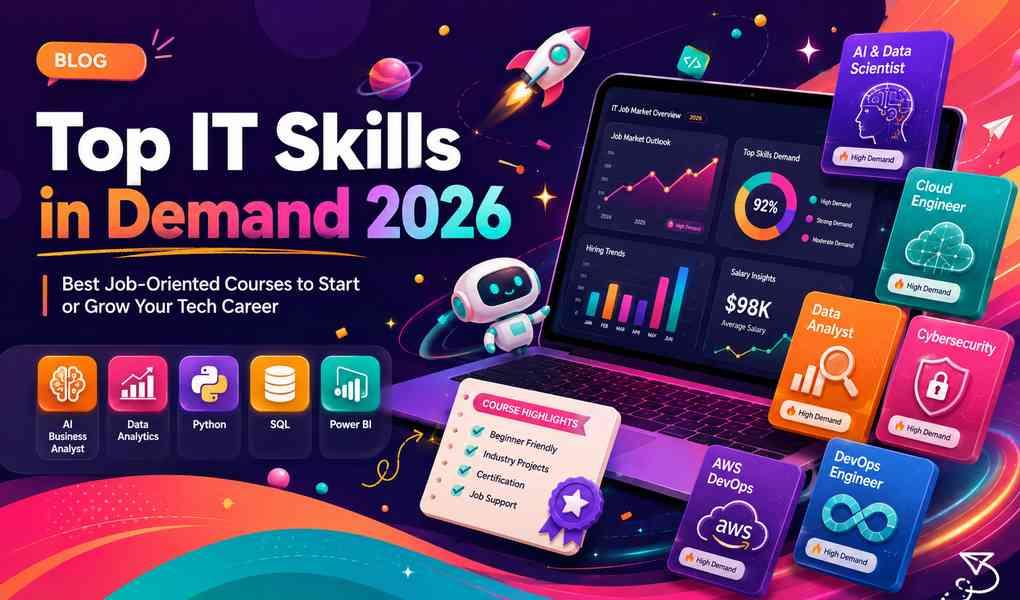
">Keterampilan IT Paling Dibutuhkan di Tahun 2026: Kursus Berorientasi Kerja Terbaik untuk memulai atau mempelajari Karier Teknologi Anda
Pasar kerja TI berubah lebih cepat dari sebelumnya. Beberapa tahun yang lalu, mempelajari satu bahasa pemrograman atau satu alat seringkali sudah cukup untuk memasuki industri teknologi. Saat ini, perusahaan mencari profesional yang dapat memecahkan masalah bisnis, bekerja dengan alat modern, memahami alur kerja proyek di dunia nyata, berkomunikasi dengan jelas, dan menerapkan teknologi dalam situasi praktis.
Inilah mengapa memilih kursus IT yang tepat sangat penting. Para pelajar tidak lagi hanya membutuhkan teori. Mereka membutuhkan pelatihan praktis, proyek nyata, tugas, persiapan resume, bimbingan wawancara, dan dukungan karir. Baik Anda seorang pelajar, lulusan baru, profesional non-IT, orang yang ingin beralih karier, atau profesional yang sudah bekerja, jalur keterampilan yang tepat dapat membantu Anda menuju peluang yang lebih baik.
Di Cyber ????Ascent, kami fokus pada pelatihan langsung yang dipimpin instruktur, tugas praktis, paparan proyek nyata, dukungan pembuatan resume, persiapan wawancara, dan bantuan penempatan kerja di bidang teknologi IT yang sangat dibutuhkan. Panduan ini menjelaskan keterampilan IT teratas yang dibutuhkan pada tahun 2026 dan bagaimana peserta didik dapat memilih jalur karir yang tepat berdasarkan latar belakang dan tujuan mereka.
Mengapa Keterampilan TI Lebih Penting dari Sebelumnya
Perusahaan-perusahaan berinvestasi besar-besaran dalam transformasi digital, otomatisasi, platform cloud, kecerdasan buatan, pengambilan keputusan berbasis data, keamanan siber, dan aplikasi perusahaan. Hal ini menciptakan permintaan yang kuat untuk para profesional terampil yang dapat mendukung teknologi proyek mulai dari perencanaan hingga implementasi.
Namun, proses perusakan juga menjadi lebih kompetitif. Kini, perusahaan mencari kandidat yang dapat menunjukkan pengetahuan praktis, bukan hanya sertifikat. Mereka menginginkan para profesional yang memahami alat, alur kerja, persyaratan bisnis, dokumentasi proyek, penanganan data, pengujian, pelaporan, dan pemecahan masalah di dunia nyata.
Oleh karena itu, pelatihan TI yang berfokus pada pekerjaan harus mencakup lebih dari sekedar ceramah. Program pelatihan yang kuat harus membantu peserta didik memahami konsep, mengerjakan tugas praktik, mengerjakan proyek secara realistis, menyiapkan resume, membangun kepercayaan diri untuk wawancara, dan menjelaskan pengalaman proyek mereka dengan jelas.
1. Analis Bisnis AI: Masa Depan Analisis Bisnis
Analisis Bisnis adalah salah satu jalur karier paling praktis bagi orang-orang yang ingin memasuki bidang TI tanpa harus menjadi programmer murni. Seorang Analis Bisnis bekerja di antara tim bisnis dan tim teknologi untuk memahami masalah, mengumpulkan persyaratan, mendokumentasikan solusi, menulis user story, mendukung pengujian, dan membantu mewujudkan proyek yang sukses.
In 2026, the Business Analyst role is evolving because of AI. Modern BAs are expected to use AI tools to improve productivity in requirement gathering, documentation, user story writing, meeting summaries, process mapping, gap analysis, UAT preparation, and stakeholder communication.
An AI Business Analyst does not simply depend on AI. Instead, they combine strong business thinking with AI-assisted workflows. This helps them work faster, organize information better, ask better questions, and support Agile delivery teams more effectively.
Skills to Learn
- Requirement gathering
- BRD and FRD documentation
- User stories and acceptance criteria
- Agile and Scrum
- Jira and Confluence
- Process mapping
- UAT support
- AI tools such as ChatGPT, Gemini, Copilot, Claude and NotebookLM
- Prompt engineering for BA tasks
Best For
AI Business Analyst training is suitable for freshers, career switchers, manual testers, QA professionals, product coordinators, support professionals, and existing BAs who want to upgrade their skills.
Cyber Ascent already offers a Business Analyst course covering SDLC, requirements, BRD, FRD, Jira, UML, testing, data modeling, and functional domain sessions.
2. Data Analytics and Business Intelligence
Data Analytics continues to be one of the most popular entry points into IT because almost every business needs reports, dashboards, insights, and data-based decision-making. Organizations collect data from websites, apps, sales systems, CRMs, ERPs, payment systems, customer support tools, and marketing platforms. But raw data has limited value unless someone can clean, analyze, visualize, and explain it.
A Data Analyst helps businesses understand what happened, why it happened, and what actions should be taken next. This role combines technical skills with business understanding.
Skills to Learn
- Excel
- SQL
- Power BI
- Data cleaning
- Dashboard creation
- KPI reporting
- Basic Python
- Business storytelling
- Data visualization
Best For
Data Analytics is suitable for students, freshers, non-IT professionals, operations professionals, finance professionals, sales analysts, and anyone who enjoys working with numbers, reports, and business insights.
Cyber Ascent has a dedicated Data Analytics course page, so this blog should internally link to that course wherever Data Analytics is discussed.
3. Data Science and Python
Data Science is a powerful career path for learners who want to go deeper into statistics, machine learning, artificial intelligence, predictive modeling, and advanced analytics. While Data Analytics focuses more on reporting and insights, Data Science focuses on models, predictions, algorithms, and intelligent systems.
Python is one of the most important skills for Data Science because it is widely used for data processing, automation, machine learning, natural language processing, and AI development.
Skills to Learn
- Python programming
- Pandas and NumPy
- Data cleaning
- Statistics
- Machine learning basics
- Data visualization
- NLP fundamentals
- Model evaluation
- Real-world data projects
Best For
Data Science is suitable for learners who are comfortable with logic, mathematics, statistics, and programming. It is also suitable for Data Analysts who want to move into advanced analytics and AI roles.
Cyber Ascent has a Python course page, and this blog should link Python-related sections to it naturally.
4. Cybersecurity and SOC Skills
As businesses move more operations online, cybersecurity has become essential. Companies need professionals who can monitor systems, analyze alerts, investigate suspicious activities, protect data, and support security operations.
Cybersecurity roles are especially important because threats such as phishing, malware, ransomware, unauthorized access, and data breaches continue to affect organizations of all sizes. A strong cybersecurity training path can lead to roles such as SOC Analyst, Security Analyst, SIEM Analyst, Vulnerability Analyst, and Cybersecurity Associate.
Skills to Learn
- Security fundamentals
- Networking basics
- SIEM tools
- Splunk
- Log analysis
- Threat detection
- Incident response
- Vulnerability assessment
- Security monitoring
Best For
Cybersecurity is suitable for learners interested in security, investigation, problem-solving, networking, and protecting systems from threats.
Cyber Ascent has a Cyber Security course page, which should be linked in this section to improve internal SEO and course visibility.
5. DevOps and AWS Cloud
Cloud and DevOps skills are in strong demand because businesses want faster deployments, reliable infrastructure, automation, scalability, and continuous delivery. DevOps connects development and operations teams and helps organizations release software more efficiently.
AWS is one of the most widely used cloud platforms, and DevOps professionals often work with cloud infrastructure, CI/CD pipelines, containers, monitoring tools, automation scripts, and deployment workflows.
Skills to Learn
- Linux basics
- Git and GitHub
- Jenkins
- Docker
- Kubernetes
- AWS fundamentals
- CI/CD pipelines
- Terraform basics
- Monitoring tools
- Cloud deployment
Best For
DevOps and AWS training is suitable for system administrators, Linux professionals, developers, testers, cloud beginners, and working professionals who want to move into cloud engineering or DevOps roles.
Cyber Ascent has an AWS DevOps course page that should be linked from this section for better internal linking.
6. SQL, Power BI and Reporting Skills
SQL and Power BI are important skills for many IT roles, not only Data Analytics. Business Analysts, QA professionals, Data Engineers, Reporting Analysts, Product Analysts, and BI Developers often need to understand data, validate records, and create reports.
SQL helps professionals retrieve and validate data from databases. Power BI helps convert data into dashboards and visual reports that business users can understand.
Skills to Learn
- SQL SELECT queries
- Joins
- Group By
- Subqueries
- Data validation
- Power BI data loading
- Data modeling
- DAX basics
- Dashboard storytelling
Best For
SQL and Power BI are excellent starting points for beginners because they are practical, widely used, and helpful across many job roles.
7. QA Automation and Testing Careers
Software testing remains a strong IT career path because every application must be tested before release. QA professionals check whether applications work as expected, identify defects, validate requirements, and ensure quality.
Manual testers can upgrade their careers by learning automation tools, API testing, mobile testing, performance testing, and Agile delivery methods.
Skills to Learn
- Manual testing
- Test scenarios and test cases
- Defect lifecycle
- Jira
- Selenium
- API testing
- Postman
- Mobile testing
- Performance testing basics
- Automation frameworks
Best For
QA Testing is suitable for freshers, non-IT professionals, support professionals, and people who want to enter IT with a structured career path.
8. SAP, Oracle and Enterprise Applications
Large companies use enterprise applications to manage finance, sales, supply chain, HR, retail operations, identity, and customer data. Skills in SAP, Oracle, PeopleSoft, Workday, Oracle Xstore, and similar platforms can lead to stable enterprise IT careers.
These roles are especially useful for professionals who want to work on business systems, configuration, support, reporting, compliance, and process improvement.
Skills to Learn
- ERP fundamentals
- SAP modules
- Oracle applications
- SQL basics
- Business process understanding
- Functional documentation
- Support workflows
- Reporting and issue resolution
Best For
Enterprise application training is suitable for working professionals, support teams, functional consultants, and learners interested in business process-driven IT roles.
How Cyber Ascent Helps Learners Become Job-Ready
Cyber Ascent is focused on practical IT training and career support. Our training model is designed to help learners move beyond theory and build confidence through hands-on learning.
Cyber Ascent Support Includes
- Live instructor-led training
- Real-time examples
- Practical assignments
- Project-based learning
- Resume preparation and optimization
- Interview preparation
- Mock interviews
- LinkedIn guidance
- Job search support
- Placement assistance
- On-job support and project guidance
- Career roadmap planning
Our goal is to help learners understand not only what to learn, but also how to explain their skills in interviews and apply them in real-world project environments.
Which IT Course Should You Choose?
The best course depends on your background, interest, and career goal.
If you are new to IT and want a practical business-facing role, start with Business Analyst or AI Business Analyst.
If you enjoy reports, dashboards, and numbers, start with Data Analytics, SQL, Excel, and Power BI.
Jika Anda tertarik dengan pemrograman, otomatisasi, dan AI, pilihlah Python, Ilmu Data, NLP, atau AI Generasi.
Jika Anda menyukai keamanan, investigasi, dan pemantauan, pilihlah Cybersecurity atau Splunk.
Jika Anda memiliki latar belakang teknis dan menginginkan peran di bidang infrastruktur atau implementasi, pilihlah DevOps dan AWS.
Jika Anda menginginkan peran dalam aplikasi bisnis perusahaan, jelajahi SAP, Oracle, PeopleSoft, Workday, atau teknologi perusahaan terkait lainnya.
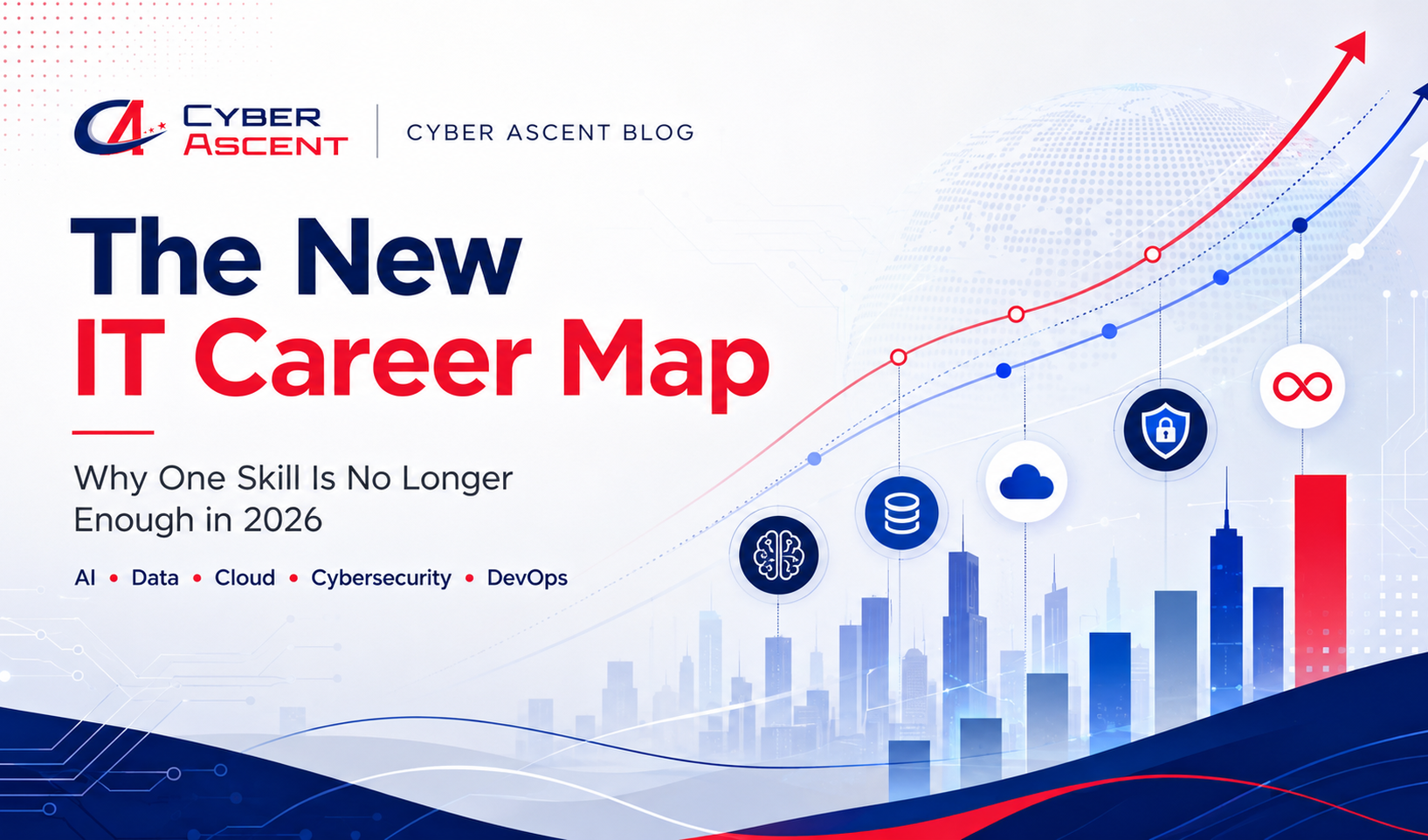
Peta Jalan Karier Akhir
Karier IT yang kuat tidak dibangun dengan mempelajari berbagai alat secara acak. Karier tersebut dibangun dengan memilih jalur yang jelas, berlatih secara konsisten, mengerjakan proyek, mempersiapkan resume, dan membangun kepercayaan diri dalam wawancara.
Peta jalan praktisnya terlihat seperti ini:
- Pilih jalur karier.
- Pelajari dasar-dasarnya.
- Berlatih menggunakan peralatan.
- Selesaikan tugas.
- Bangun proyek secara real-time.
- Siapkan resume yang kuat.
- Latihan soal wawancara.
- Lamar pekerjaan secara konsisten.
- Terus tingkatkan keterampilan Anda.
Industri TI akan terus berubah, tetapi para profesional yang terus belajar, berlatih, dan beradaptasi akan selalu memiliki peluang yang lebih baik.
Mulailah Karier IT Anda dengan Cyber ????Ascent
Ingin membangun keterampilan IT yang siap bekerja dengan proyek nyata dan bimbingan ahli?
Cyber ????Ascent menawarkan pelatihan langsung yang dipandu instruktur, dukungan pembuatan resume, persiapan wawancara, dukungan pencarian kerja, dan bantuan penempatan kerja di berbagai teknologi yang paling dibutuhkan saat ini.
Program Pelatihan Cyber ????Ascent Populer
- Analis Bisnis AI
- Analis Bisnis
- Analisis Data
- Ilmu Data
- Python
- SQL
- Power BI
- Keamanan Siber
- Splunk
- DevOps
- AWS
- GETAH
- Peramal
- Otomatisasi QA
- Selenium
- Jawa
- BERSIH
- Generasi AI
- NLP
- Blockchain
- OKTA IAM
- MuleSoft
WhatsApp :
Email : info@cyberascent.com Situs web :
www.cyberascent.com
Cyber ????Pendakian – ??Belajar. Membangun. Mendapatkan Pekerjaan.
Analis Bisnis AI, Analisis Data, Analis Bisnis, Keamanan Siber, DevOps, AWS, Ilmu Data, Python, SQL, Power BI, Pelatihan TI, Kursus Berorientasi Pekerjaan, Beralih Karier, Bantuan Penempatan Kerja, Pelatihan Langsung yang Dipandu Instruktur, Karier Teknologi, Peta Jalan Karier TI, Cyber ????Ascent


Comments (0)