



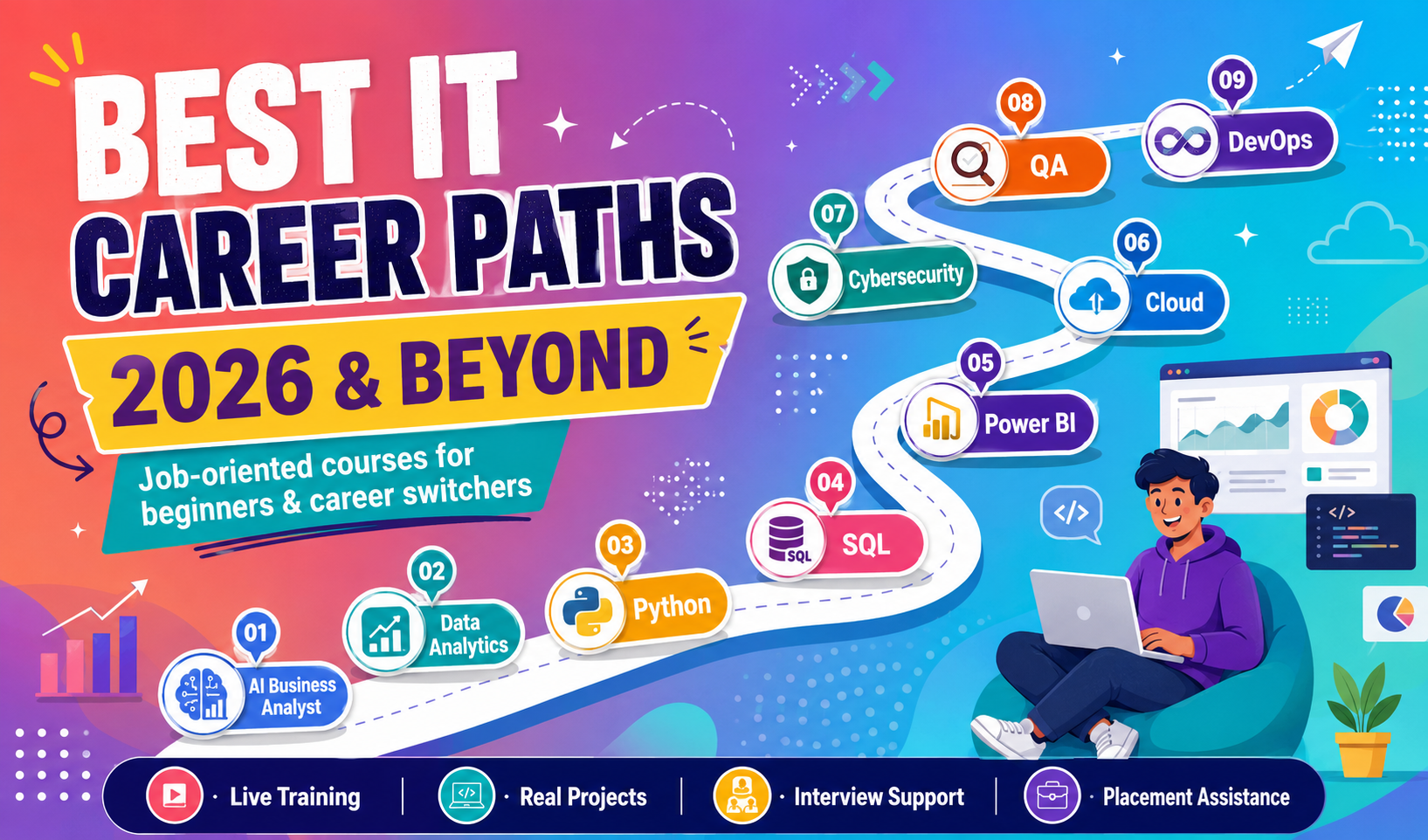
Planning your IT career for 2026 and beyond requires more than simply choosing a popular technology. The job market is changing rapidly, and companies are no longer hiring candidates only because they completed a course or earned a certificate. Employers are looking for people who can understand real business problems, work with modern tools, communicate clearly, support project delivery, and apply practical skills in real-time work environments. This is why job-oriented IT training has become extremely important for students, freshers, non-IT professionals, career switchers, and working professionals who want to build a stable career in technology.
In the coming years, the strongest career opportunities will belong to professionals who can combine technical knowledge with practical problem-solving ability. Technologies such as Artificial Intelligence, Data Analytics, Cloud Computing, Cybersecurity, DevOps, Automation, Business Analysis, Power BI, Python, SQL, QA Testing, and enterprise applications are becoming essential across industries. Companies in banking, healthcare, retail, insurance, logistics, education, e-commerce, telecom, and consulting are investing heavily in digital transformation. This means they need skilled professionals who can support data-driven decisions, automate business processes, improve customer experiences, secure systems, manage cloud platforms, and deliver technology projects efficiently.
For beginners and freshers, choosing the right starting point is very important. Many learners make the mistake of jumping into advanced technologies without understanding their own background, interest, and career goal. Someone who enjoys communication, documentation, stakeholder interaction, and business problem-solving may find Business Analysis or AI Business Analysis a better fit. Someone who enjoys working with numbers, reports, dashboards, and insights may be more suited for Data Analytics, SQL, Excel, and Power BI. A learner who enjoys coding and logic may choose Python, Data Science, Automation, or Software Development. A person who is interested in security, investigation, and monitoring may explore Cybersecurity or SOC Analyst training.
For non-IT professionals and career switchers, the IT industry still offers strong opportunities, but the approach must be practical and structured. Career switchers often need training that explains concepts in a simple way, connects technology to real business examples, and helps them understand how work happens in actual projects. Courses like Business Analyst, AI Business Analyst, Data Analytics, QA Testing, SQL, Power BI, Cybersecurity fundamentals, and Cloud basics can be strong entry points because they do not always require deep programming knowledge at the beginning. With the right guidance, assignments, project exposure, and interview preparation, learners from non-technical backgrounds can gradually build confidence and move toward IT roles.
For working professionals, 2026 and beyond will be about upgrading skills and staying relevant. Many traditional roles are changing because of AI, automation, cloud adoption, and data-driven business models. Business Analysts are now expected to use AI tools for requirement gathering, documentation, user stories, UAT preparation, process mapping, and stakeholder communication. Data professionals are expected to understand dashboards, SQL, cloud data platforms, and business insights. QA professionals are expected to learn automation, API testing, Agile tools, and AI-assisted testing workflows. Developers and infrastructure professionals are expected to understand DevOps, cloud deployment, CI/CD, and modern engineering practices. Continuous learning is no longer optional; it is becoming a career survival skill.
AI Business Analyst is one of the most important emerging career paths for the future. Organizations are not simply looking for people who can use AI tools; they need professionals who can understand business needs and use AI responsibly to improve productivity. An AI Business Analyst can use tools like ChatGPT, Gemini, Copilot, Claude, and other AI platforms to support requirement analysis, create documentation drafts, summarize meetings, generate user stories, identify gaps, prepare test scenarios, and improve communication. However, AI does not replace the Business Analyst mindset. The real value comes from combining business understanding, stakeholder management, structured thinking, Agile knowledge, documentation skills, and AI-powered productivity.
Data Analytics is another strong career path for 2026 and beyond because every business wants to make smarter decisions using data. Companies need professionals who can clean data, write SQL queries, create dashboards, track KPIs, identify trends, and explain insights to business teams. Tools like Excel, SQL, Power BI, Tableau, and Python basics are highly useful for learners who want to enter reporting, analytics, business intelligence, or data-driven roles. Data Analytics is also a practical option for people from finance, operations, sales, HR, administration, and non-IT backgrounds because it connects business knowledge with technical reporting skills.
Cloud, DevOps, and Cybersecurity will also continue to grow because businesses are moving applications, data, and infrastructure to modern platforms. Cloud engineers help organizations manage scalable infrastructure. DevOps professionals help teams deploy software faster and more reliably. Cybersecurity professionals protect systems, monitor threats, investigate alerts, and support secure digital operations. These roles are especially important as companies expand remote work, online transactions, digital platforms, and cloud-based services. Learners who enjoy technical troubleshooting, systems, automation, security, and infrastructure can explore these career paths for long-term growth.
QA Testing and Automation remain important because every software product must be tested before it reaches users. QA professionals play a key role in ensuring quality, identifying defects, validating requirements, and supporting product releases. Beginners can start with manual testing, test scenarios, test cases, defect lifecycle, Jira, and Agile basics. Later, they can move into Selenium, API testing, mobile testing, performance testing, automation frameworks, and AI-assisted testing. QA can be a strong entry point for people who want to understand software projects before moving into automation, business analysis, product roles, or quality engineering.
Enterprise technologies such as SAP, Oracle, Workday, PeopleSoft, Salesforce, ServiceNow, MuleSoft, and identity access management platforms are also valuable for learners who want to work with large business systems. These tools are used by major organizations to manage finance, HR, supply chain, customer service, retail operations, compliance, and enterprise workflows. Professionals who understand both business processes and enterprise applications can build stable careers in implementation, support, testing, reporting, configuration, and functional consulting roles.
Cyber Ascent helps learners choose and build the right IT career path through practical, live instructor-led training. Our approach is not limited to theory. We focus on real-time examples, hands-on assignments, project-based learning, resume preparation, interview support, job guidance, and placement assistance. Learners are trained to understand how concepts are used in real projects, how to explain their work in interviews, how to prepare strong resumes, and how to build confidence for recruiter, manager, and client discussions.
One of the biggest challenges learners face is confusion. They often ask questions like: Which IT course is best for me? Can I move into IT without coding? Is Data Analytics better than Business Analysis? Should I learn Python or Power BI first? Is Cybersecurity suitable for beginners? Is AI going to replace jobs? Which skills will be useful in 2026 and beyond? This blog is designed to answer those questions clearly and help learners make better career decisions based on their interests, background, and long-term goals.
The future of IT belongs to people who can learn continuously, practice consistently, and adapt to new tools and workflows. Certificates may support your profile, but practical knowledge, project confidence, communication skills, and interview readiness are what help you stand out. Whether you want to start your first IT role, switch from a non-IT background, upgrade your existing career, or prepare for better opportunities, choosing the right job-oriented training path can make a major difference.
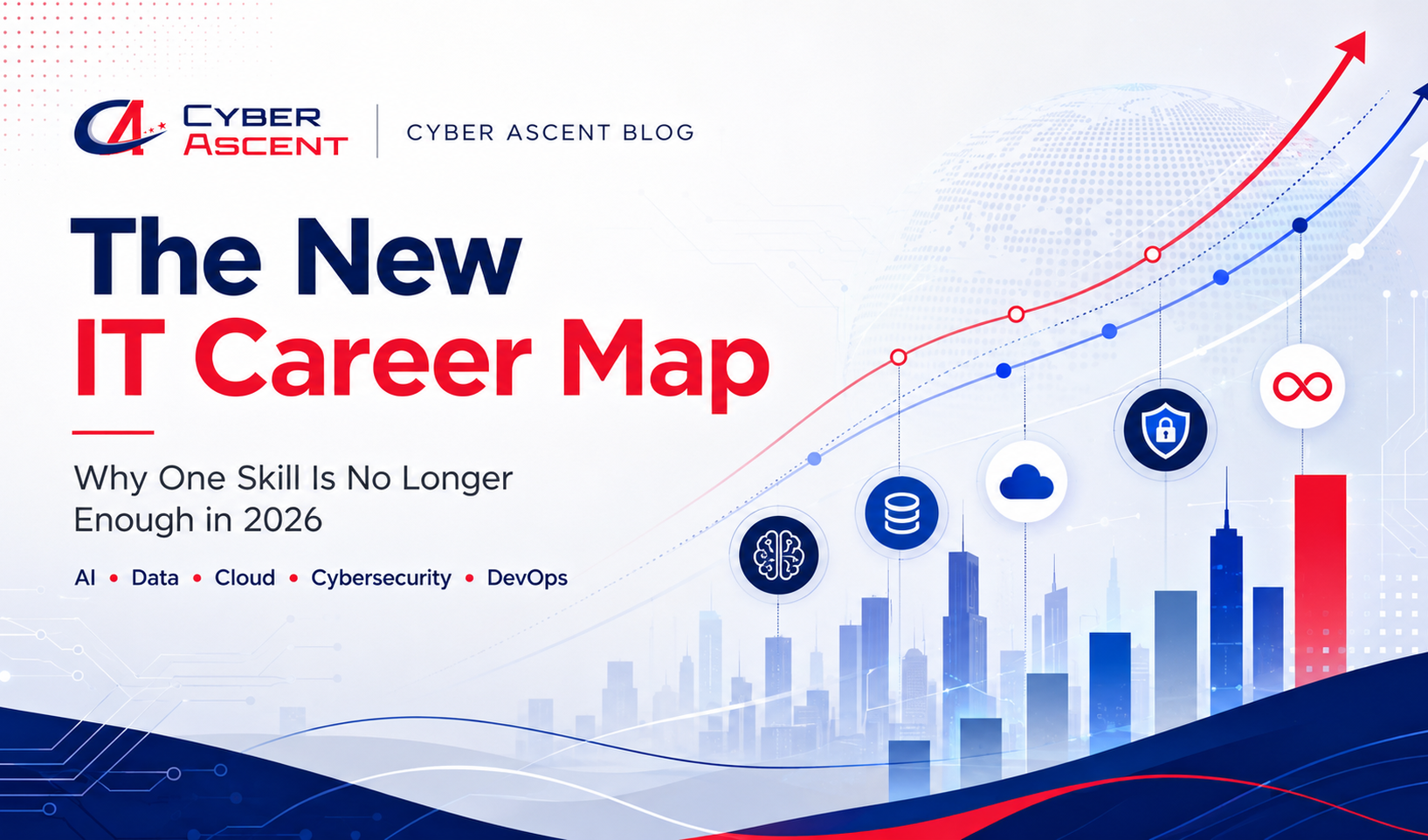
As we move into 2026 and beyond, the best IT career paths will be those that combine business understanding, data skills, cloud knowledge, AI awareness, cybersecurity readiness, automation, and real-world project experience. Cyber Ascent is committed to helping learners build these skills step by step through structured training, practical guidance, and career-focused support. This blog will help you explore the most relevant IT courses, understand which path may be right for you, and take the next step toward a stronger, future-ready technology career.
Best IT Career Paths 2026 | Job-Oriented IT Courses | Cyber Ascent
Best IT career paths 2026, IT career paths for beginners, job-oriented IT courses, best IT courses for career switchers, IT courses for freshers, non-IT to IT career, IT training with placement assistance, AI Business Analyst course, Business Analyst training, Data Analytics course, Python training, SQL training, Power BI training, Cloud training, Cybersecurity course, QA Testing course, DevOps training, AWS training, career switch to IT, live instructor-led IT training, Cyber Ascent, IT career roadmap, future IT skills, best tech careers 2026


Comments (0)